Software/Virtual auction software
Virtual auction software, for an auction with no room in it.
Everybody is watching a stream. The stream is going out to four platforms at once. The bidding has to happen in one place, in real time, and it has to keep working when somebody’s signal drops. That is the problem this solves.
If there is a room, you want the other page
Two different events get called the same thing, and the software they need is not the same.
If you have a hall with people in it and an auctioneer at the front, and you are adding online bidders so the people who could not travel can still take part, that is a hybrid auction. It is a genuinely hard problem, mostly because a bid from the floor and a bid from a sofa have to compete in the same lot at the same price. We wrote about it at length: live auction software.
This page is the other one. Nobody is in a room. The auction exists as a broadcast, and its audience is whoever is watching, including people who found it forty seconds ago and have never heard of the charity. That changes what the software has to do.
The thing that decides whether it works
You can send a stream to YouTube, Instagram, TikTok and Twitch at once, and plenty of tools do that well. The bidding, though, happens in one place, and that place is the auction page.
So a multistreamed auction has a shape to it: several ways in, one destination, and an evening that succeeds or fails on how many viewers travel between the two. In practice they arrive through the link in each platform’s profile, switched to the auction page in the run-up and pointed at from the broadcast itself.
That single fact should drive the choice of software, and it usually does not. Most platforms are built for a silent auction with a clock, then have a video embed added to the side. What matters here is the opposite: how quickly a stranger who has just arrived can go from watching to bidding.
What that means in practice. A short memorable URL rather than a long one. A page that loads fast on a phone on mobile data. Registration that asks for as little as possible before it will accept a bid. And the current lot visible the instant the page opens, so somebody arriving mid-auction can see what is happening without scrolling.
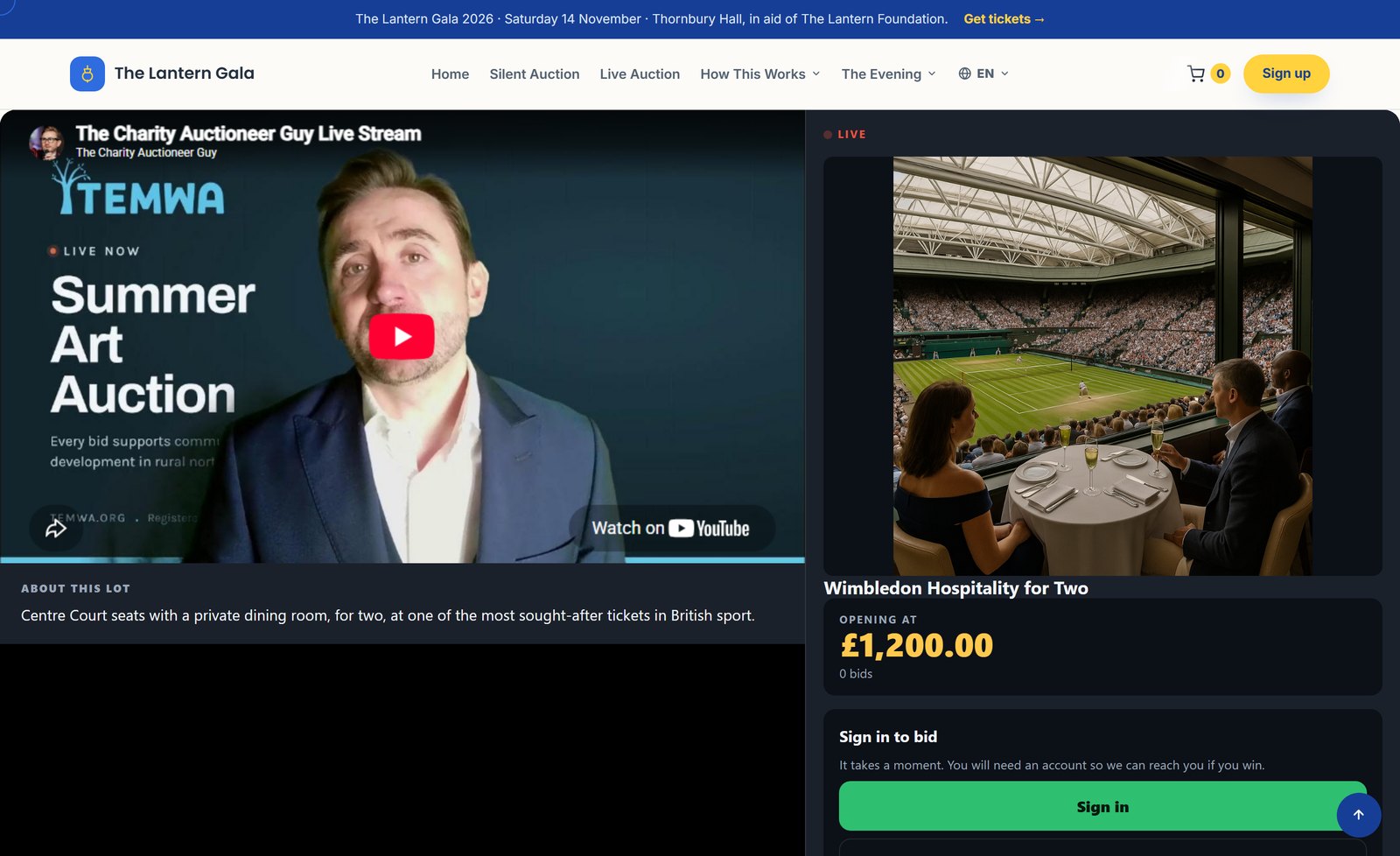
Bidding beside the video, not on top of it
The watch page puts the stream and the lot side by side, with the bid controls under the thumb. The lot panel does not overlay the video, which sounds like a small decision and is not: text over a moving picture is unreadable, and a bid button floating over a stream is a button people press by accident and then have to be refunded.
The bid buttons offer a stated amount rather than opening a box asking for a maximum. In a called auction the auctioneer is saying a number and the viewer is answering it. “What is the most you would pay?” is the wrong question in that moment and it loses the bid.
It is stream agnostic, deliberately
Paste a YouTube, Vimeo or Zoom link and it works out the embeddable URL itself. There is no separate embed code to find, and no supported-platforms list to fall foul of.
That matters more than it sounds when you are multistreaming, because the multistream happens upstream of the auction entirely. Your production setup sends the same programme to as many platforms as you like, and one embed comes into the auction page. The software does not know or care how many places the broadcast is going, which is exactly what you want: the day you add a fifth platform, nothing here needs changing.
Letting a stranger bid before they have added a card
The default everywhere is that a card has to be on file before a bid is accepted, because that is what lets the winner be charged the moment the hammer falls without anybody chasing them.
On a streamed auction that default costs you. Somebody who found the auction ninety seconds ago, on a platform they were scrolling anyway, is asked for card details before they are allowed to join in. Most of them do not. The barrier is doing its job and the job is wrong for this audience.
So it is a switch. Turn it on and the requirement lifts everywhere at once, on the bid, on buy-now, on the lot page notice and in the live room, rather than in three places out of four.
The trade, stated plainly. Those bids are unsecured. Nothing can be taken automatically when they win, so they are emailed a payment link and somebody has to chase whoever does not pay. On a lot worth £80 that is a good trade. On a lot worth £4,000 it probably is not, and the switch is per event so you can decide which kind of evening you are running.
Somebody has to be able to say when the lot is finished
A virtual auction still needs a human deciding the pace, and the console for that is built for a phone held one-handed. Every lot on one screen with its live price and who is winning it. One tap puts a lot up. Two taps sell it, and the second is deliberate, because selling is the one thing you cannot take back with a shrug.
Undo exists anyway for ten minutes, and refuses once the winner has paid, at which point it is not a mis-tap, it is a refund, and that belongs in your accounts rather than on a console.
When the connection goes, and it will
An in-person auction fails gracefully because there is a person in the room holding it together. A virtual one has a network between the auctioneer and every single bidder, and that network is somebody’s phone on a train.
So both screens carry a deadline on every request, a watchdog that unsticks the loop if nothing has painted for twenty seconds, and recovery when the tab comes back or the connection returns. That is not a feature list, it is a bug that cost a real event a real evening before it was found. The auctioneer’s board froze on its last painted state with the live indicator still showing green, and he carried on calling lots from a snapshot minutes old.
It is worth asking any supplier what their software does in that exact situation. The answer tells you whether they have run one of these or only sold one.
The strangers are the point, and they are the bit software usually drops
A hall holds the people you invited, and every one of them already knew the charity well enough to buy a ticket. A multistreamed auction is watched by people who did not, and that is the real argument for holding one.
Which puts a requirement on the software that a room never does. Somebody who arrived in the middle of lot four and registered to bid is not a transaction to be closed and forgotten. They are a new supporter who has just given you their name, and if the platform treats them as an order line you have paid for the reach and thrown away what it bought.
So everyone who registers is a person with a record, not a receipt: what they bid on, what they won, what they gave, whether they Gift Aided it. That list exports, and it syncs, so on Monday it is in the CRM the fundraising team actually uses rather than trapped in an auction tool. Thank-yous go out automatically and personally, because the thank-you is where a one-time bidder becomes a second-time one.
Everything gets posted, because there is no room to collect it in
At a gala half the lots go home in somebody’s car. A fully virtual auction has no such night: every physical lot has to be sent, to people who have never stood in front of you and whose address you do not have.
So the winner is asked for one, once, in the email they already open, with no sign-in to get past. There is a screen showing what is still outstanding and one button to chase it. How that works in full.
Worth asking any supplier. After the event, what exactly do you get, and in what format? A platform that gives you a total and a spreadsheet of winners has told you what happened. It has not given you the audience you just spent an evening earning.
What this is not
It is not streaming software and it does not pretend to be. It will not encode your video, mix your cameras, or push your broadcast to four platforms. For that you want OBS Studio, which is free and excellent, plus a restreaming service, and somebody who knows how to drive both.
This is the auction underneath the broadcast: the lots, the bidding, the money, the console and the record afterwards. The two jobs are genuinely separate, and any platform claiming to do both well is worth a second look.
If you would rather not assemble it yourself, Kevin runs the whole thing, production included: hiring a virtual auctioneer.
Whose money, and what it costs
You enter your own Stripe keys, so every payment lands in your account. We never hold your donors’ money, we take no percentage of what you raise, and there is no per-bidder fee that grows with your audience. A stream that goes unexpectedly well should not produce an unexpectedly large invoice.
The platform is included in every engagement, and available on its own.
Questions people actually ask
What is virtual auction software?
Software that runs an auction where nobody is in a room: the lots, the live price, the bidding, and a watch page where guests see the stream and place bids in the same place. It is distinct from silent auction software, which runs on a timer with nobody calling it.
Can it stream to more than one platform at once?
The multistream happens upstream of the auction, in your production setup, so you can send the broadcast to as many platforms as you like. The auction page takes one embed and does not know or care how many places the stream is going, which means adding a platform needs no change here.
Do we need OBS Studio?
For a multistreamed or produced broadcast, yes, plus a restreaming service. This is not streaming software and does not pretend to be. It is the auction underneath the broadcast: the lots, the bidding, the money and the console.
Can people bid without being at the event?
That is the normal case here. Anybody watching can register and bid. Where there is also a room, floor bids and online bids compete in the same lot at the same price, and a standing online maximum answers the room automatically.
What happens if a bidder loses their connection?
Both the bidder's page and the auctioneer's console carry a deadline on every request, a watchdog that unsticks the loop if nothing has painted for twenty seconds, and recovery when the tab returns or the connection comes back. This was a real bug on a real event before it was a feature.
Who holds the money?
You do. You enter your own Stripe keys and every payment lands in your account. We never hold your donors' money, take no percentage of what you raise, and charge no per-bidder fee that grows with your audience.
No obligation, and never a percentage of what you raise
Let’s talk about your number.
Thirty minutes on your event, your audience and your target, and an honest view of whether a virtual auction is the right shape for it.
Book a discovery call→