Insights/Mobile Bidding for Charity Auctions: How It Works
Mobile Bidding for Charity Auctions: How It Works
TL;DR
- Mobile bidding lets guests bid from the phone in their pocket, in the phone browser, with no app to download.
- Text-to-bid means a guest can raise a lot with a couple of taps, then get an automatic alert the second someone tops them.
- Those outbid nudges are the whole point: a bidder who knows they have been beaten comes back in, and paper sheets can never do that.
- I have run auctions for 20 years, and the tech should fan the competition in the room, not replace it.
- The platform is included at no cost when you book me to auctioneer or host your event, or £995 a year if you would rather run it yourself.
The phone in your guest’s hand is the best fundraising tool in the room, and most events waste it. That is why I built mobile bidding into my charity auction platform. It simply means people bid from their own phone rather than scribbling on a paper sheet or waving a card. Two features do the heavy lifting: text-to-bid, which turns placing a bid into a couple of taps, and automatic outbid alerts, which pull a beaten bidder straight back into the contest. This page explains how both work, and why real-time nudges lift the total.

What is mobile bidding at a charity auction?
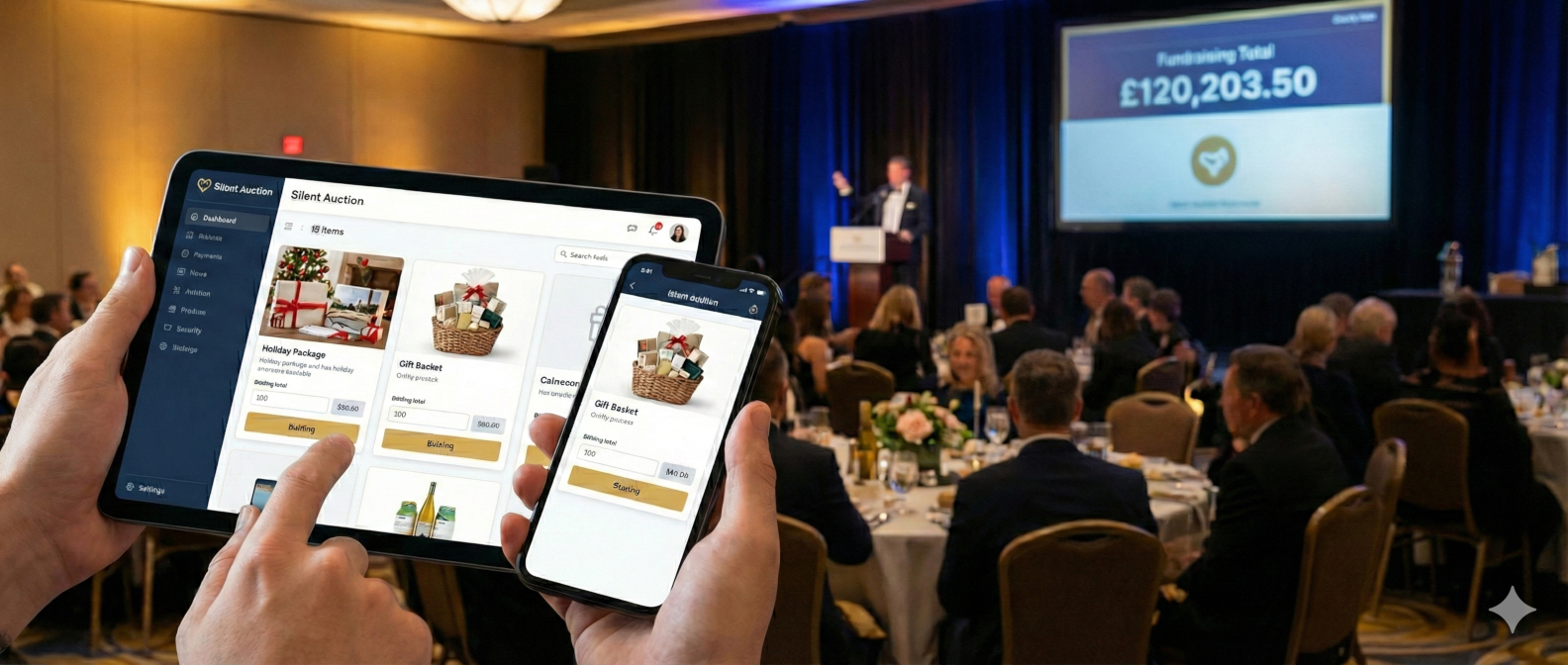
Mobile bidding is a way of running an auction where every guest bids from their own smartphone instead of a paper form or a raised paddle. They open a web page, they see the lots, and they place bids with their thumb. The bids update live, so everyone can watch the current price climb in real time.
That last part matters more than it sounds. On a paper sheet, a guest writes a number, walks away, and has no idea what happens next until they wander back to the table. With mobile bidding, the contest is live in their hand. They feel the pressure of being beaten, and they act on it. Online bidding turns a quiet, slow trickle of numbers into an active race, and a race is what raises money.
It suits a silent auction at a dinner, a week-long online run, or a hybrid where the quiet lots sit on phones and I take the headline items live on the mic.
How does text-to-bid work?
Text-to-bid means a guest places a bid with a couple of taps rather than filling in a form each time. They pick a lot, they see the current price and the next valid increment, and they confirm. That is the whole action. No pen, no queue at the table, no working out whether £110 beats the last scribble.
Under the bonnet, the mobile bidding software is doing the tidy-up work for them. It knows the current high bid, it sets the minimum next step, and it records who bid what and when. Nobody is deciphering handwriting at the end of the night, and there is no argument about who got in first, because the timestamp settles it.
You can also let a guest set a maximum, so the system bids on their behalf up to a ceiling they choose. They tell it “take me to £300 if you have to”, then they enjoy their dinner while the software defends their position. That keeps a serious bidder in the running even when they have stepped away from their phone.
Why do outbid alerts raise more than paper sheets?
Outbid alerts raise more because they close the gap between “I have been beaten” and “I know I have been beaten”. On a paper sheet, that gap can be an hour, and by the time the guest strolls back the lot may be gone. The moment someone tops their bid, the platform sends them a nudge: you have been outbid on the spa weekend, the price is now £240, tap to go again.
I have watched what that does to a room. A guest who thought they had won relaxes, then their phone buzzes, and something competitive kicks in. They did not want that lot at £180 an hour ago as much as they want it right now that a stranger has tried to take it. That is not a trick, it is human nature, and good fundraising works with it rather than against it.
Here is the difference laid out plainly.
| What happens | Paper sheet | Mobile bidding |
|---|---|---|
| Placing a bid | Walk to table, write a number | Text-to-bid, a couple of taps |
| Finding out you are beaten | Only if you wander back | Instant outbid alert |
| The comeback bid | Rare, often too late | One tap, straight back in |
| Final record | Handwriting to decipher | Clean, timestamped log |
The paper sheet is passive. Mobile bidding is active, and an active bidder spends more.
Does mobile bidding need an app to download?
No. My mobile bidding runs in the ordinary phone browser, so there is nothing to download and nothing to install. A guest scans a code or taps a link, and they are in and bidding within seconds. That is deliberate, and it protects your total on the night.
Think about the alternative. If a guest has to find an app store, search for the right silent auction app, wait for a download, then create an account, you have lost a chunk of them at the door. Every extra step is a place where a slightly reluctant bidder gives up and goes back to their drink. Older guests and less confident phone users drop off fastest, and those are often the people with the deepest pockets.
Running in the browser strips all of that out. If you want to see the guest’s side of it, the download page shows exactly how they get on, and the silent auction software page covers the quiet-bidding mechanics in more detail. No app, no faff, no barrier between your guest and their next bid.
Mobile bidding still needs someone holding the room
Here is where I will be honest with you, because I have learned it the hard way. The tech is a tool, not a magician. Mobile bidding fans the competition, but it does not create the energy in the first place. That still comes from the room, and from whoever is running it.
I once took an auction at a big event that was running late. There was no speech and no video to tee it up, and I made the mistake of starting while people were still talking. I did not stop to get them quiet. Only a fraction of the room heard the lots, and one man bid on an item he could not clearly hear. Whoever holds the room holds the total, and that night I did not hold it.
The lesson stuck. Use mobile bidding to remove friction, to keep the quiet lots ticking over, and to nudge beaten bidders back in. But get the room quiet first, tee the auction up properly, and let the technology fan a fire you have already lit. The phones handle the mechanics so I can do the part that actually moves money: reading the room and pushing at the right moment.
How do you set up a silent auction with mobile bidding?
You set it up by loading your lots, setting a starting price and a bid increment for each, then opening the auction and sharing the link with your guests. The platform handles the rest: the live prices, the text-to-bid, the outbid alerts, and a clean record at the close. Most organisers have it built in an afternoon.
A few practical steps make it run well:
- Load lots with a clear photo, an honest description, and a sensible starting price. Start too high and nothing moves.
- Set your increments so the price climbs with a bit of pace, not in tiny creeping steps.
- Open bidding early, even a few days before, so keen guests can get in before the night.
- Brief the room that they will get a buzz when they are outbid, and that they should bid straight back.
For the full walk-through, my silent auction guide takes you through it end to end, and the silent auction page shows the format in action.
simple to use, and free when you book me
Let me be straight about the cost, because it is the whole point of how I built this. You can run the mobile bidding platform yourself, at no extra cost, with no per-lot cut and no tip skimmed from your donors. That is not a trial or a stripped-back version, it is the software.
And if you want the room worked properly on the night, book me to auctioneer your event and the platform comes with me, at no extra cost. You are not paying twice, once for a person and once for the tech. Hire me on the mic and the mobile bidding is simply included.
If you would rather talk it through, call 07596 851647 and we will work out whether an online run, a silent auction on phones, or a live night with me holding the room is the right shape for your cause. A powerful result comes from a powerful team behind a powerful charity, and the technology should be fanning the competition, never getting in its way.
No obligation, and never a percentage of what you raise
Let’s talk about your number.
A conversation about your event, your room, and what the night should be raising.
Book a discovery call→